


Most people in the Lowcountry start researching generators in the middle of an outage, not before one. The power goes out on a Tuesday afternoon, the restoration map says Friday, and by Wednesday night the house is sitting at 85 degrees with everything in the refrigerator going soft. At some point in that process, you panic, pull out your phone, and start looking at generator prices.
That research usually stalls in the same place. You find a 22 kW unit and a 26 kW unit that look close to identical, separated by a few thousand dollars, and nothing on either spec sheet tells you which one your house needs. Even more confusing, if you ask three contractors, you may get three different answers, each delivered with total confidence.
That leaves you wondering; what size generator do you actually need? The short answer is that most Charleston homes land between 16 kW and 26 kW. The range is that wide because square footage, which is what nearly every sizing chart is built on, turns out to be a poor predictor of how much power a house actually pulls. A 2,200-square-foot home with gas heat and city water may run comfortably on an 18 kW unit. The identical floor plan with a heat pump and a well pump can need 26 kW. Two neighbors, same builder, eight kilowatts apart.
Sizing is the decision that determines whether your generator works during the outage you bought it for. Get it wrong on the low side and the unit trips offline the first time your air conditioner cycles on. Get it wrong on the high side and you paid thousands of dollars for capacity that never gets used, then burn extra fuel every time it runs. This guide walks through the same calculation our electricians use on a whole house generator installation, so you can walk into the conversation already knowing where you’ll most likely land.
The quick version
Sizing a generator requires four steps of simple math, and you can get within one size class of the right answer with nothing but a pen and paper. Step three is the one people get wrong.
List what you want running during an outage.
Add up the running watts.
Add the largest single starting surge, then subtract that appliance’s running watts.
Multiply by 1.25.
Divide by 1,000 and you have your target size in kilowatts.
Whole house generator size by square footage
When sizing a whole house generator, most people start with square footage. The generator size recommendations shown below will give some direction. However, treat these suggestions as a sanity check on a quote, not as an answer for the proper unit size for your home.
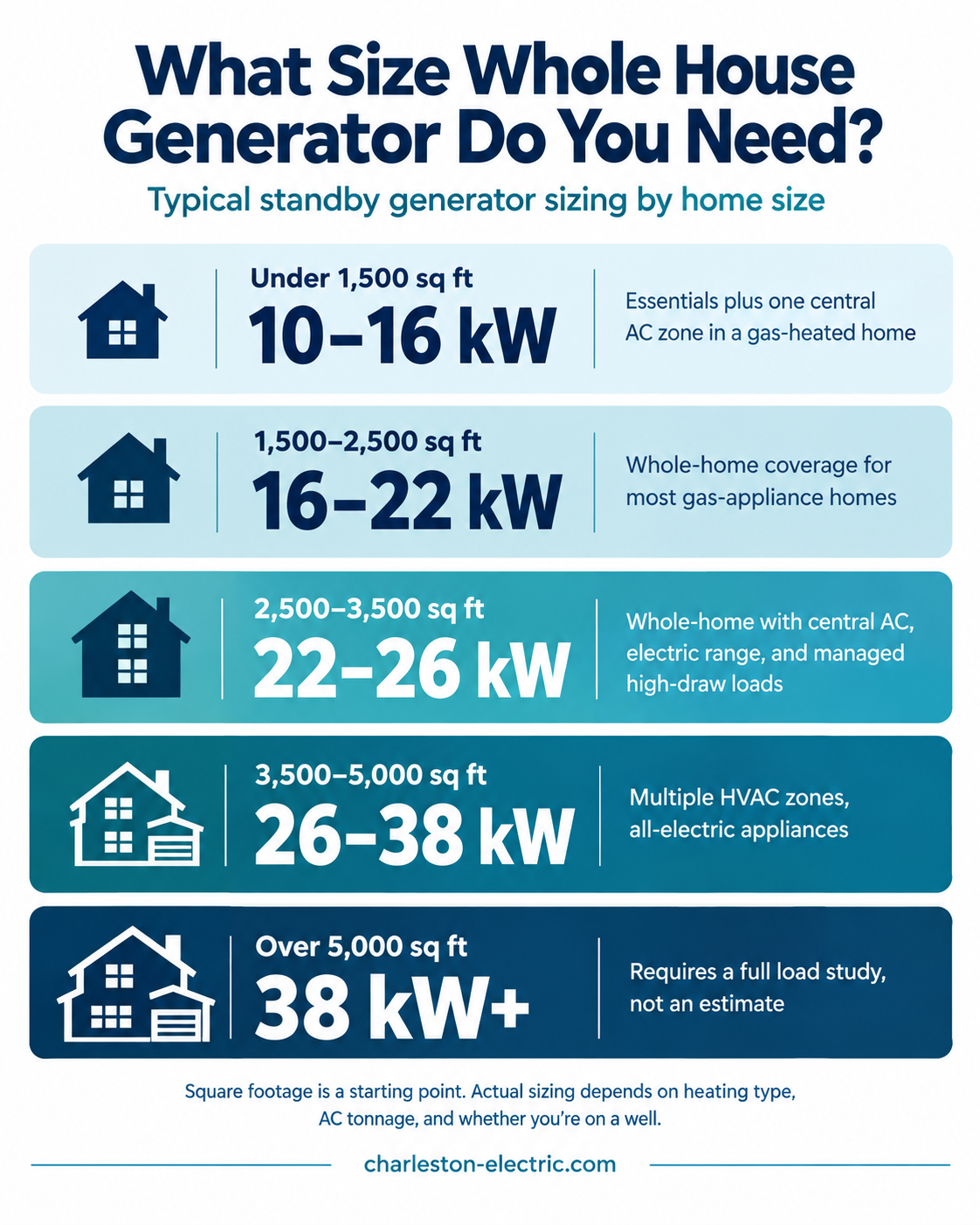
Other contractors publish ranges as wide as 22 kW to 36 kW for a single bracket. That span covers almost every residential unit on the market. In other words, it tells you nothing in a real situation. The numbers above are tighter because they assume a typical Lowcountry home: gas or heat-pump heating, one or two AC zones, city water. If you change any of those assumptions, the number can move significantly
Why two identical houses need different generators
A generator has no idea how big your house is. It responds to how many watts are moving through the panel at a given moment, and square footage only loosely predicts that. What sets the number is which of your major systems run on electricity and which run on gas.
Heating is the single biggest variable. A gas furnace pulls a few hundred watts to run its blower and that’s about it. A heat pump doing the same job draws thousands, and it spikes hard every time the compressor kicks on. Swap one for the other in an otherwise identical house and the generator requirement can move four kilowatts on its own.
Water is the next one. On city water, the utility keeps pressure in the line whether your power is on or not. On a well, which describes a good portion of Berkeley and Dorchester counties along with the rural stretches of Johns Island and Wadmalaw, your pump is your water supply. No power, no water, no toilets. And that pump is another motor with another startup surge to absorb.
Here is the same 2,200-square-foot home, four different ways.
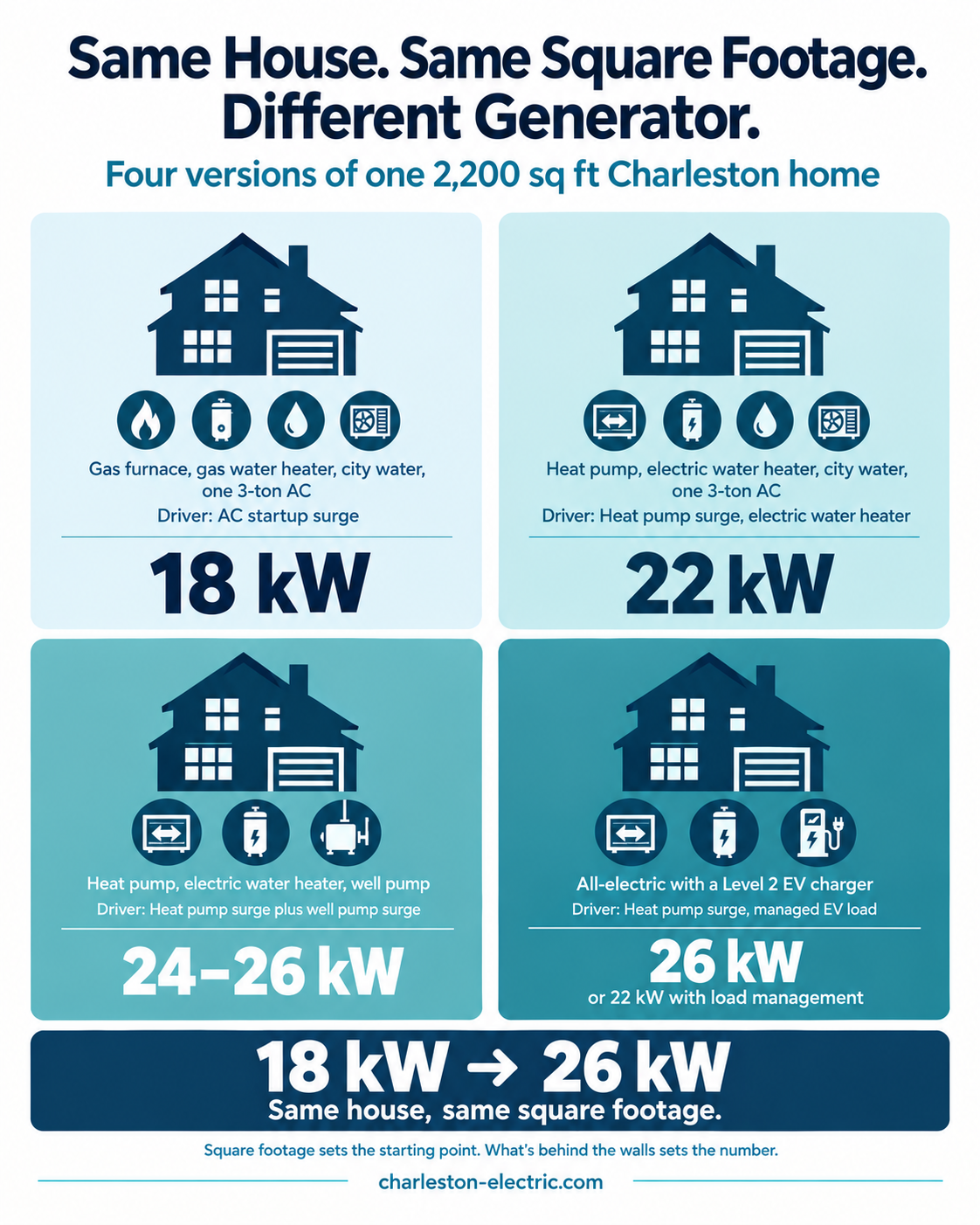
Start with the version most common in older Charleston neighborhoods: gas furnace, gas water heater, city water, one 3-ton air conditioner. The only serious surge in that house is the AC compressor starting. 18 kW would likely cover this scenario.
Now take the same floor plan and make it all-electric on the heating side. A heat pump and an electric water heater replace the gas appliances, and the generator has to absorb the heat pump’s startup surge on top of everything else. Now, you’ll need 22 kW to manage a whole-home power outage. Nothing about the house changed. The walls, the windows, and the square footage are identical. One equipment decision made by a builder, possibly decades ago, added four kilowatts.
Add a well and you’re at 24 to 26 kW. Add a Level 2 EV charger in the garage and you’re at 26 kW, or 22 kW if a load management module is handling the charging load.
That’s an eight-kilowatt spread across four houses of the exact same size on four different streets. In real money, the difference between the first version and the last is usually several thousand dollars of equipment, plus a different fuel line, sometimes a different pad, and occasionally a service upgrade.
This is why a sizing chart can only ever be a starting point, and why a contractor who quotes you a number over the phone without asking about your heating type is guessing. The good news is that you can get most of the way to the right answer yourself, because the four systems that drive this are the four you already know about.
How to calculate your generator size
Step 1: Decide what "backup power" means to you
There are two options when it comes to backup power, and the one you pick changes everything downstream.
Essential circuit coverage keeps the refrigerator, some lighting, the internet, the furnace fan, and a handful of outlets alive. It's cheaper. It also means sitting in a dark, 85-degree house in August while the generator hums along outside.
Whole-home coverage runs the air conditioning. In Charleston, that's the whole reason to own a generator. Our recommendation to nearly every homeowner here is whole-home with load management rather than essentials-only, because essentials-only is the configuration people typically regret three days into an outage.
Step 2: Add up running watts
Running watts are what an appliance draws once it's going. Find the number on the nameplate, usually a sticker on the back or the side of the unit. Here are some typical figures for a Charleston home:
3-ton central air conditioner: 3,500–5,000 watts
Heat pump, air handler running: 2,000–4,000 watts
Electric water heater: 4,500 watts
Well pump, 1 HP: 1,000 watts
Refrigerator: 600–800 watts
Electric range, one element plus oven: 3,000–5,000 watts
Sump or lift pump: 800–1,200 watts
Lighting, electronics, internet, chargers: 500–1,000 watts
Step 3: Account for starting watts
This is the step that separates a generator that works properly from one that trips constantly. Anything with a motor pulls a short, violent burst of power at startup, often two to three times its running draw.
The number worth memorizing: a 3-ton central air conditioner runs on roughly 3,500 to 5,000 watts, but can demand 15,000 to 18,000 watts for the two or three seconds it takes the compressor to spin up. If your generator can't absorb that spike, it shuts down, and it shuts down every single time the thermostat calls for cooling.
A soft-start kit on the AC compressor can cut that surge dramatically and sometimes lets you drop a full size class on the generator. Ask about it. On a Charleston home it often pays for itself in the price difference between a 22 kW and a 26 kW unit.
Step 4: The formula
You don’t need capacity for every motor starting at once, because that doesn’t happen. You need capacity for everything running while the biggest motor starts:
(Total running watts) + (Highest starting watts) − (Running watts of that same appliance) = Peak demand
Then add the safety margin: Peak demand × 1.25 = Your target generator size
The subtraction step is what usually trips people up, so it’s worth some explanation. Your air conditioner’s running watts are already in the first number. When you add its starting surge, you’d be counting that appliance twice unless you back the running figure out. If you skip the subtraction, you’ll oversize by several thousand watts.
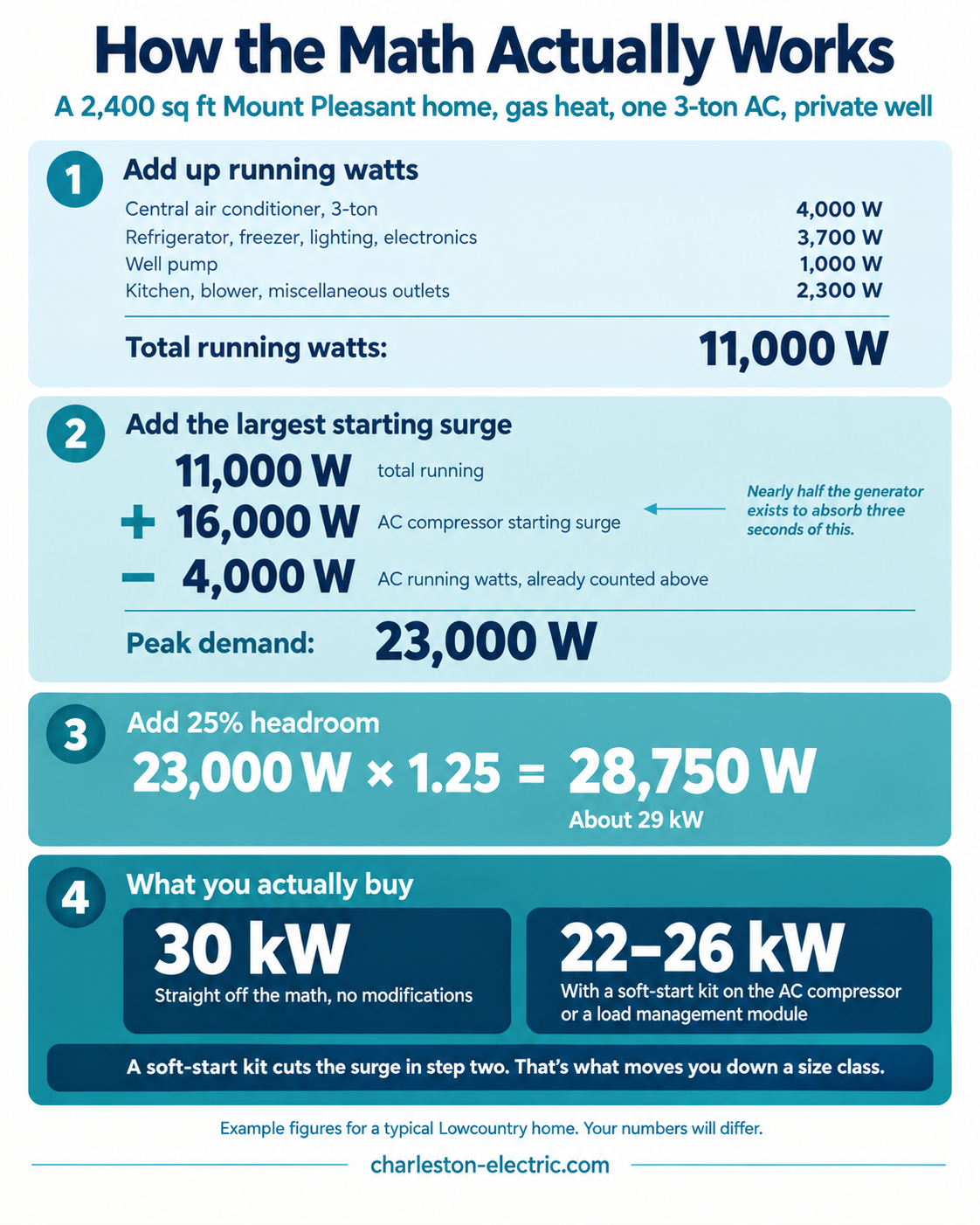
A 2,400-square-foot home in Mount Pleasant with gas heat, one 3-ton air conditioner, and a private well comes to 11,000 running watts. The air conditioner is the biggest starter on the list at 16,000 watts, against 4,000 running. Peak demand is 11,000 + 16,000 − 4,000, or 23,000 watts. Add 25 percent and you’re at 28,750 watts, which is right around 29 kW.
Taken at face value, that number sends you to a 30 kW unit. But look at where the weight sits. Sixteen thousand of those watts exist to cover roughly three seconds of compressor inrush, and the rest of the time that capacity does nothing at all. You’re being asked to buy a much larger generator to survive a moment that lasts less time than it takes to read this sentence.
A soft-start kit on the compressor cuts that inrush by more than half. Run the same calculation with a reduced surge and the house lands on a 22 or 24 kW unit instead of a 30. The kit costs a fraction of the difference between those two generators, and most homeowners have never heard of one because the manufacturers who publish sizing guides have no reason to tell you how to buy a smaller unit.
Step 5: Consider load management before you size up
A load management module watches the generator's output and briefly pauses a low-priority appliance when the system approaches its limit. In practice it means the dryer waits ninety seconds while the air conditioner starts.
Load management regularly lets a home run on a generator one or two sizes smaller than the raw math suggests. On most Charleston installs it's the difference between a 22 kW unit and a 26 kW unit, which is real money both at purchase and at every propane fill.
What each generator size actually runs
Generators get sold by their kilowatt rating, which means at some point you’re staring at a number on a quote trying to work out if it will actually cover your home. Here’s what each size realistically handles in a Charleston home, and where each one starts to strain.
14 kW: Essential circuits and limited cooling. This unit will keep your refrigerator, lights, internet, and furnace blower going indefinitely. What it won’t do is run central air alongside everything else. In a climate where the air conditioning is the reason you bought a generator, that’s a significant limitation.
18 kW: The practical floor for whole-home coverage here. Runs one central AC zone, refrigeration, lighting, and gas appliances at the same time. Tight if you add a well pump or an electric water heater to the mix.
22 kW: The most common standby size in the Lowcountry, and the one most homes end up on. Central air, kitchen, well pump, and household electronics, with load management handling the moments when several large loads want to start at once. Gets stretched by a second HVAC zone or an all-electric appliance package.
24–26 kW: Where all-electric homes land, along with anything running two HVAC zones or both a heat pump and a well pump. Also the right call if an EV charger or a pool is anywhere in your five-year plan, since retrofitting a larger generator later costs far more than sizing up now.
30 kW and above: Large homes, multiple air handlers, and the point where you move from air-cooled to liquid-cooled units. Different equipment, different maintenance, different price class. At this size a professional load study isn’t optional.
How fuel type changes the size you need
The same generator produces less power on propane than on natural gas, and the gap is more significant than most people realize. A Generac unit sold as 22 kW is rated 22 kW on natural gas and 19.5 kW on propane. Same engine, same price, two and a half kilowatts apart depending on what you feed it.
That’s an important factor when you’re sizing close to the line. A house that needs 21 kW is covered by a 22 kW unit on natural gas, but comes up short on propane. Unfortunately, you won’t find out until the first outage when the generator is running wide open trying to keep up. If you’ll be burning propane, size against the propane rating on the spec sheet instead of the number on the box.
Which fuel you use is usually decided for you by geography. If there’s a Dominion gas line at the street, that’s the simpler option: no tank, no refills, no running out on day four, and the supply generally stays pressurized through a storm. Large parts of the barrier islands and the outer stretches of Berkeley and Dorchester counties have no gas service at all, which makes propane the only option. Some homeowners on gas lines still choose propane deliberately, on the theory that a tank in the yard is one less utility that can fail.
Sizing mistakes we see most often
Almost every sizing error falls into one of two camps: a load somebody forgot to count, or a load somebody counted twice. Both are easy to avoid once you know where they hide. These four account for most of what we run into on service calls to generators that were sized by someone else.
Sizing off square footage alone. A sizing chart gets you in the neighborhood. It can’t see your heating type, your AC tonnage, or whether you’re on a well, and those are the three things that actually set the number.
Forgetting the well pump. If you're outside municipal water service, no power means no water, including no toilets. A well pump also carries a significant startup surge. It belongs in the calculation from the beginning, not as an afterthought.
Buying the biggest unit available. Oversizing costs more upfront, burns more fuel, and causes wet stacking, which is unburned fuel building up in the exhaust when an engine runs at too low a load for too long. It shortens the life of the unit you overpaid for.
Ignoring what you're about to add. Plenty of homeowners size a generator for the house they have and then add an EV charger, a pool pump, or a heated workshop eighteen months later. Any one of those can add several kilowatts. Sizing for the house you’ll have in five years costs a little more now and far less than replacing an undersized generator later.
Why Charleston homes often need a larger generator
National sizing guides are written for a national average, but the Lowcountry isn’t an average place. There are several factors specific to this region that can push that number up substantially.
Cooling load is nearly year-round. Air conditioning runs here from April into October, and it is the single largest electrical load in most local homes. In a market where the generator's main job is heating, you can sometimes size smaller. Here, the AC compressor sets the floor.
Outages last longer than a few hours. Hurricane and tropical storm restoration in Charleston County is measured in days, not hours. A generator sized only for essentials is tolerable overnight. It is miserable on day four in September.
Well water is common outside the city. Large parts of Berkeley and Dorchester counties, plus the rural stretches of Johns Island and Wadmalaw, run on private wells. That's an extra pump and an extra surge.
Elevated and marsh-adjacent homes carry extra pumps. Lift stations, sump pumps, and dehumidification in crawl spaces all add load that a typical inland home doesn't have.
If you want the number for your specific house instead of a range, our electricians will measure your actual panel loads on site, and that assessment comes free with any whole house generator installation quote in the Charleston area.
If you already own a generator that trips or bogs down when the air conditioner starts, that’s a different call. An undersized unit and a failing one produce nearly identical symptoms, and a generator repair visit will tell you which one you’re dealing with before you spend money replacing equipment that may be fine.
Frequently asked questions
What size generator do I need for a 2,000 square foot house?
Most 2,000-square-foot homes need 18 kW to 22 kW for whole-home coverage. A gas-heated home with city water and one AC zone can often run on 18 kW. The same home with a heat pump, an electric water heater, or a well pump moves to 22 kW.
Can a 22 kW generator run a whole house?
In most Charleston homes, yes. A 22 kW unit paired with load management covers central air, refrigeration, lighting, kitchen appliances, and a well pump in homes up to roughly 3,000 square feet. All-electric homes and homes with two HVAC zones usually need more.
What size generator do I need to run central air?
Size for the compressor's starting surge, not its running draw. A 3-ton AC runs on 3,500 to 5,000 watts but can spike to 15,000 to 18,000 watts at startup. Most homes running one central AC zone plus normal household loads need at least 18 kW, and a soft-start kit on the compressor can reduce that requirement.
How many watts does it take to run a whole house?
A typical Charleston home draws 10,000 to 16,000 running watts with everything on, and needs 20,000 to 35,000 watts of generator capacity once starting surges and safety margin are included.
Is it bad to buy a generator that's too big?
Yes. Beyond the higher purchase price and fuel consumption, a generator running at very low load develops wet stacking, which fouls the exhaust and shortens engine life. Correctly sized beats oversized.
Do I need a professional load calculation before I buy?
You should have one, and most manufacturer warranties require professional installation regardless. An electrician measures actual panel loads rather than estimating from nameplates, checks your service capacity, confirms the transfer switch configuration, and handles permitting with Charleston County. The calculation in this guide gets you to a well-informed conversation. It doesn't replace the site visit.
Before you sign a quote
Run your numbers through the four steps and you’ll land within one size class of the right answer. That’s enough to read a proposal critically, notice when a contractor has quoted you a 30 kW unit without asking about your heating type, and ask whether a soft-start kit would get you the same coverage for less money.
The last step still takes a site visit. We’ll measure what your panel is actually pulling, account for your AC tonnage and well pump, and give you a size with the reasoning attached so you can check it against the math you already did. No pressure to buy anything on the spot. Schedule a free generator sizing assessment.